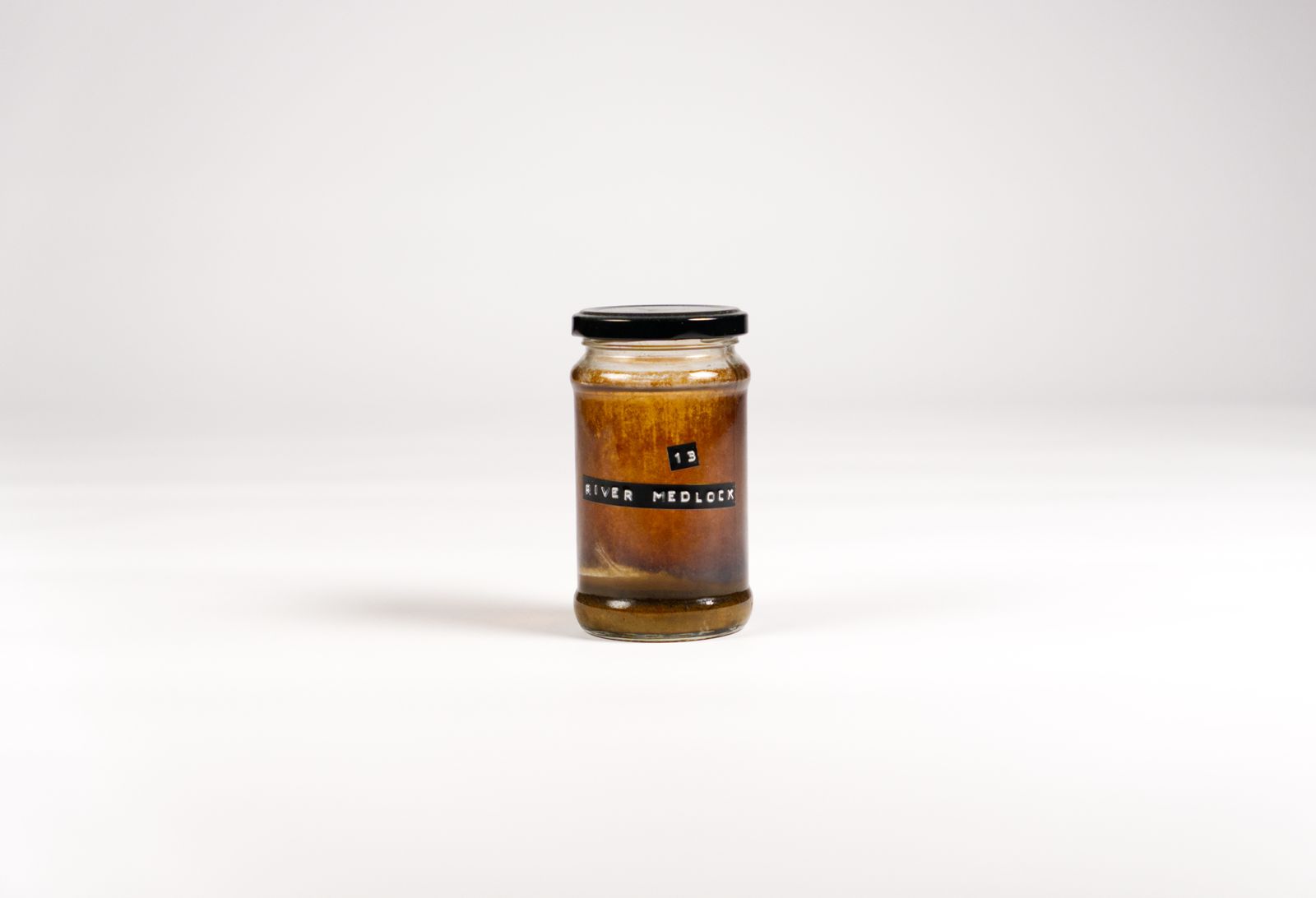
Water (River Medlock)

Description
Water collected from the banks of the River Medlock (where the river has been daylighted in Mayfield Park). Sediment has precipitated out of this water and gathered at the bottom of the jar, as well as (somehow) staining the sides of the jar.
Materials
Curator's Notes
*On every jar of water collected in 2024 I will leave this note: "whenever I collect water going forward I will photograph each stage of its time in the jar. The jars of water I have now look very different today than they did when I first collected them, and I wish I'd documented that" It turns out that the security guards in Mayfield Park get a little bit suspicious when you grub around collecting stuff from the banks of the Medlock. Or maybe they were a bit confused. Either way its fine because they were lovely, if a bit bemused, when they finally came to ask what I was doing. I grabbed this water with a bit of river sediment, and, whaddya know, it actually had lil creatures living in it for a bit. After the sediment settled the eggs must have hatched and tiny thin wormy critters waved up from the bottom (and retreated if I tapped the jar). What I take from this is that the Medlock can't be as polluted as it once was. Tiny worms are part of a balanced ecological system, right? Probably. Unfortunately I was a bad worm guardian and they finally died/disappeared. I can only assume they rotted back down into the mush and now this water is disappointingly static and dead. As my pal with an environmental science degree pointed out to me "things need oxygen to live, maybe leave the lid off next time if you want to keep the worms". While you probably don't really need an environmental science degree to know that, I think it helps you remember stuff like this. If I get another jar of Medlock I will be asking this pal for tips and tricks to keep a little habitat going for as long as possible. The River Medlock flows in total for about sixteen miles from its source in Oldham, but for the last few miles it is heavily culverted and hidden underneath the city of Manchester. This may not come as a suprise but in the late 1850s, the Medlock was heavily polluted. Old maps from the time show things like tanneries and dye works right next to the river, not only using the water, but dumping the used water back in. Now there were people trying to fix this; in 1855 Frederick Crace Calvert, a Professor of chemistry at the Manchester Royal Institution, wrote an article on the "Purification of Polluted Streams" for the Journal of the Society of Arts. He described water from the Medlock as "black and foetid". Not ideal. To fix this he experimented with adding the "disinfecting powder of Dr. Angus Smith and Mr. McDougall", finding that the "flocculent precipitate thus produced falls rapidly to the bottom of the vessels in which the experiment is made, leaving a clear transparent fluid". As a bonus: this transparent fluid didn't smell. Frederick was not the first person to use lime to clean dirty water, but it is interesting to watch ideas and processes end up in Manchester as attempts were made to fix the city's dirty water problems. While he was no lime pioneer, Frederick at least has the honour of being the first person to commercially produce carbolic acid, used as a disinfectant, and established a large Mancunian factory to do it. If you want to go congratulate him he is buried at St Saviours Church, Chorlton on Medlock (you know, that place where there's just the graveyard left and an empty space in the middle where the church was).