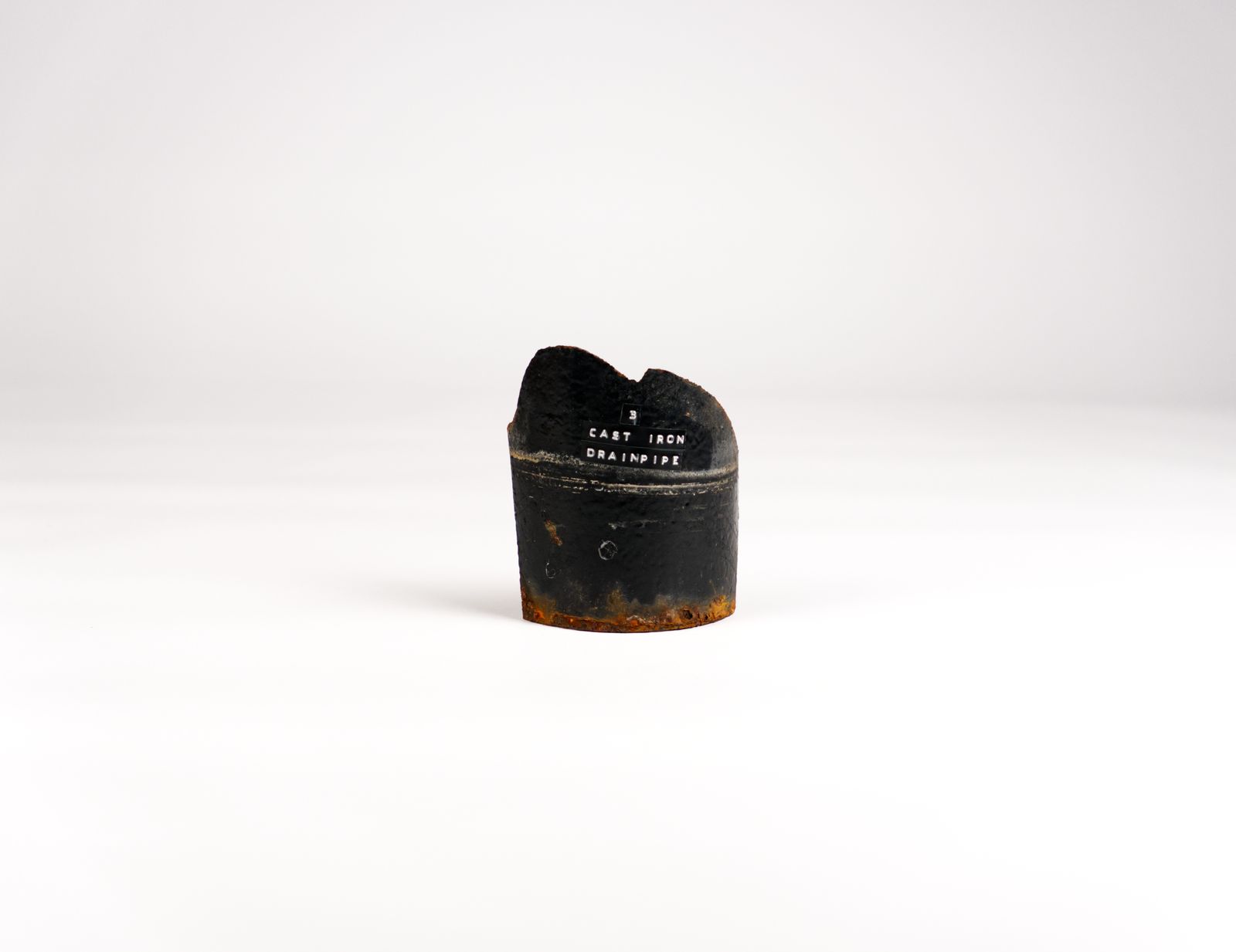
Curator's Notes
I will now quote to you from the book: House Drainage and Sanitary Fitments, by Gerald J. G. Jensen, published in 1900 by the Sanitary Publishing Company.
“Rain-water pipes discharging into foul drains, must be disconnected by means of surface traps. Rain-water pipes discharging into storm water drains may be connected direct and utilised as ventilators. Under no circumstances, however, may rain-water pipes by utilised for the ventilation of foul drains.”
Now I know very little about drain pipes, but a surface trap is a curved pipe that holds a lil bit of standing water, forming an airtight barrier that stops bad smells from the above mentioned foul drains making their way back up into the sensitive human nose.
Before 1800 stone, ceramic, lead and wood were all used for water supply and drainage pipes. Apparently Versailles, that Fancy French Place [eat the rich], had the earliest known cast iron pipes installed in 1664 for all those ostentatious fountains. In 1758 someone called Isaac Wilkinson was granted a patent for the production of cast iron pipes- something to do with forming moulds and cores in the casting process. In Manchester cast iron pipes had entirely replaced stone pipes by 1818.
But progress is never linear. In the 1900s Gerald J. G. Jensen tells me that cast iron pipes were still working on superseding stoneware pipes in sewage systems elsewhere. Pros included the material properties of cast iron:
- can be manufactured in long[er] lengths
- which means fewer joins and therefore fewer weak spots
- cast iron is stronger and more resistant to fracture
- joints on cast iron can be made strong and reliable
- “the adaptability of the material [cast iron] to every variety of form”
Cons included: cost. Even with advanced tech, cast iron was still 10 to 30% more costly than stoneware.
Money: hindering progress since forever.