Curator's Notes
Some drivers think road markings have a bad aura. That’s why they ignore them.
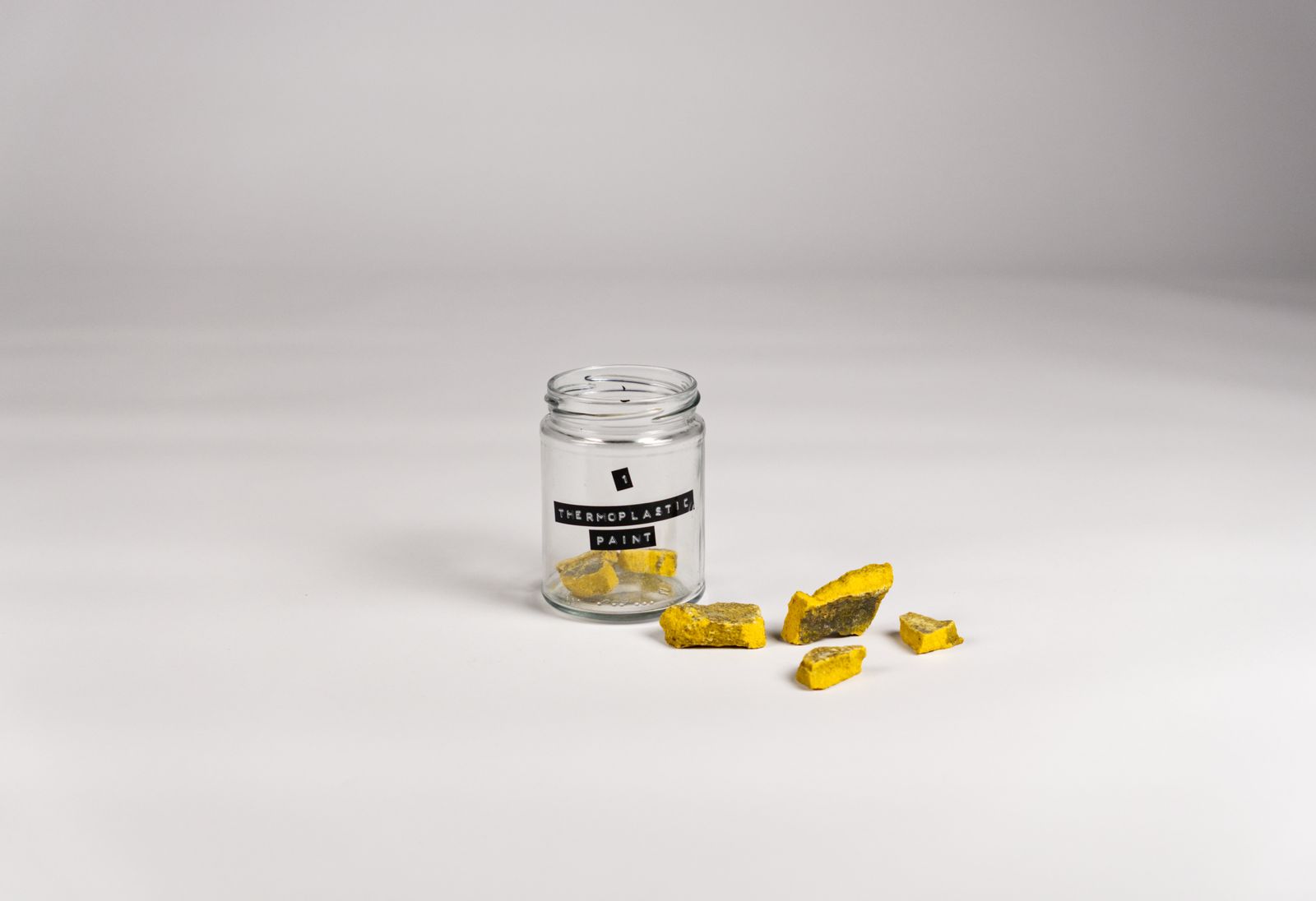
But at the Material City we run towards bad auras (at the speed limit), so here we have what we assume is some thermoplastic paint, commonly used for road markings all over the world. I say “we assume” because road markings can also be water based paint or epoxy based paint. But both of these other options don’t last as long in high traffic areas, so its probably the heavy duty stuff.
If it is thermoplastic paint, then it’s full of plastic, yellow pigment (or white, or red), packing materials, and glass microspheres. Because it has to be durable, sticky, yellow (or white, or red), and visible. It also has to be liquid on application, and dry very quickly because we humans need to get on with our busy lives and people complain about road closures.
Road markings= road safety. Or at least, that’s the idea. Worldwide road traffic accident stats may disagree. But still, we try. Road safety is generally thought of as the result of an interaction between three (main) factors: human, vehicle, road. Road safety strategies look at the things that cause crashes, and aim for holistic solutions.
One holistic solution is the standardised system of symbols and signs that appear on the road itself; part of the “universal visual road semiotics” that have gradually been put into place around the world.
If I were a better philosopher I would go into the concept of semiotics, and how materials create a semiotic environment for humans. Perhaps I’d even make a much better diagram to explain them. But I’m not that person, so you get this:
Development of road marking visual language ——> Materials (glass, plastic, pigment etc) ——> process (mixing, heat) ——> thermoplastic paint ——> process (application, heat) ——> road markings ——> signs/symbols ——> human behavior (good driving? Fewer accidents?)
In conclusion: the physicality of road traffic markings is one of the more obvious ways that materials influence human behaviour.